
 Oshiete!
 Berita
  Masjid
 Info Kurs
 Media Jepang
Analysis: US rejects majority of UN human rights panel resolutions on diversity
MAINICHI
| Januari 18, 2026
12 0 0
0
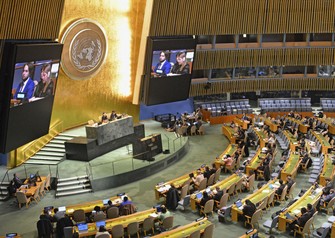
NEW YORK (Kyodo) -- The United States, which under President Donald Trump has pursued efforts to roll back "diversity, equity and inclusion" programs, also voted against a majority of the resolutions endorsed by the main human rights committee of the U.N. General Assembly in 2025, a Kyodo News analysis has found.
The finding comes as Trump, a year into his second term as president, has directed the United States to withdraw from dozens of U.N. agencies whose work and values are deemed contrary to the country's interests, with Secretary of State Marco Rubio leveling scathing criticism at "a sprawling architecture of global governance" shaped by "progressive ideology."
The U.N. General Assembly's Third Committee is in charge of social, humanitarian and cultural issues. Diplomats representing countries the world over attend its meetings from October to December each year to discuss a wide range of topics, including women's rights and gender equality, as well as the human rights situations in North Korea and Myanmar.
Resolutions drafted after negotiations are mostly adopted by consensus at the committee before being sent to the main assembly of the 193-member body. But according to an analysis of data published by the U.N. Secretariat, the United States frequently opposed such a consensus-driven approach in 2025.
The data showed that in the committee session beginning in 2024, 16 resolutions, or 33 percent, were adopted by vote. But in the session beginning in 2025, 41 resolutions, or 75 percent, were adopted by vote, about 80 percent of the time at the request of the United States.
Washington sought votes on resolutions with titles such as "Rights of Indigenous Peoples" and "Rights of the Child." The texts passed with opposition from only the United States, or one or two other countries in some cases, while more than 160 countries voted in favor.
Although resolutions of the committee are nonbinding, they carry symbolic significance as an amalgamation of opinions of the world's governments on global issues. Unlike in the U.N. Security Council, no country holds veto power in the committee.
U.S. diplomats stated during votes on dozens of resolutions that U.N. bodies should stop using resources "where there is little or no impact" and focus instead on the core role of maintaining international peace and security.
In many votes, Washington took aim at "problematic language" relating to what it considers divisive cultural concepts such as diversity, equity and inclusion, transgender issues and climate change.
In a joint statement of European Union members and some other countries at a General Assembly meeting to consider the committee's recommendations, Erik Laursen, deputy ambassador of Denmark to the United Nations, expressed the EU's regret at the increase in votes.
Noting that consensus on several once-unanimous resolutions had been broken, he said, "We are concerned that this undermines our collective efforts and the constructive spirit of striving for consensus."
In December, the U.S. mission to the world body said in a statement that the country's opposition to many of the resolutions "did not signal an argument over the merits of certain noble causes."
It insisted, rather, that Washington did not want to waste resources on negotiating "performative" texts, and that it would work to end the practice going forward.
At the time, Jonathan Shrier, then deputy U.S. representative to the U.N. Economic and Social Council, told the General Assembly that Washington will continue its opposition "until member states seriously and dramatically reorient the focus" to core responsibilities.
Louis Charbonneau, the director of U.N. affairs for Human Rights Watch, said in a phone interview that the resolutions are an "important record" to raise issues that are often neglected and easily forgotten.
They also serve to reaffirm human rights standards and put violators on notice, he said, citing an annual resolution on North Korean human rights abuses that Washington supported in 2025.
In February last year, the United States withdrew from the U.N. Human Rights Council, a 47-member Geneva-based rights body. Unlike in the council, all member states in good standing have a vote in the General Assembly and its six subsidiary committees, one of which is the Third Committee.
On Jan. 7, Trump ordered the U.S. withdrawal from most of the regional commissions of the U.N. Economic and Social Council. They are among the 31 U.N. agencies Washington said it is exiting, along with 35 other international organizations.
(By Eric Peters)
komentar
Jadi yg pertama suka

Belum Jadi Warga?
Daftar yuk!