
 Oshiete!
 Berita
  Masjid
 Info Kurs
 Media Jepang
Scam prevention by Osaka Pref. banks triples after new ordinance takes effect
MAINICHI
| Mei 31, 2026
2 0 0
0
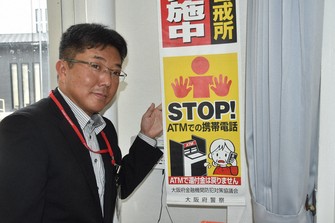
OSAKA -- Banks in Osaka Prefecture managed to prevent 119 scams between January and March this year -- roughly triple the figure for the same period the previous year, prefectural police have disclosed.
It has been some 10 months since the prefectural government enacted a revised ordinance on the development of safe communities in the prefecture, which incorporates measures to combat special fraud, where victims are defrauded of cash or other items over the phone or through communication tools. These measures include banning elderly people from talking on the phone near ATMs.
The Mainichi Shimbun investigated the impact of the prefecture's measures, said to be the first of their kind in Japan.
On the evening of Aug. 1, 2025, a man in his 70s approached the Kumatori Gomon Post Office in Kumatori, Osaka Prefecture, while talking on his mobile phone. This was the first day after the revised ordinance came into effect. When he tried to use an ATM while talking on his phone, a postal staff member stepped in.
"You can't use your phone here," the staff member said.
The man protested, "I'm talking to the police," but the staff member persisted, and as soon as they took the phone from the man, the call was disconnected. The man had been instructed by the caller to transfer money "for an investigation," and the employee's action at that moment spared him from becoming a victim.
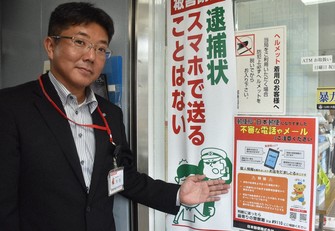
The revised ordinance includes provisions banning elderly people from talking on their phones while using ATMs, requiring financial institutions to report suspected fraud cases to police, and allowing transfer limits to be set for ATM users aged 70 and older. It is the first ordinance in Japan to clearly restrict individual behavior, such as phone use at ATMs, and to make anti-fraud measures mandatory for financial institutions. It allows bank staff to intervene directly at the moment when a fraud might occur.
Kumatori Gomon Post Office head Satoshi Oishi said that before the ordinance took effect, he received a police briefing and shared the information with staff.
"Now that the ordinance explicitly states 'no phone conversations,' it's easier to engage with people who are on the phone," he said.
The tactic of guiding people to ATMs to have them transfer money is commonly used in fraud schemes such as "refund scams" falsely promising medical expense reimbursements. Elderly people have been particularly vulnerable to such scams.
Between January and March last year, before the ordinance was enacted, financial institutions in Osaka Prefecture prevented 39 such scams, but during the same period this year, following enactment of the measures, the number of prevented cases more than tripled, reaching 119, according to Osaka Prefectural Police.
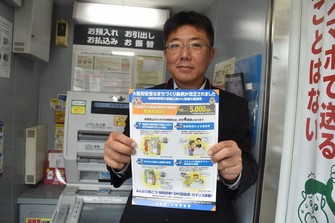
Police say the number of victims aged 65 and older is on a downward trend, with 2,266 in 2023, 1,882 in 2024, and a preliminary figure of 1,741 in 2025.
The prefectural police's prefectural citizen safety division commented, "The ordinance revision has had a certain effect."
At the same time, the overall damage from special fraud in the prefecture remains large. In 2025, the total amount lost to such scams reached about 13.7 billion yen (around $86.18 million), more than double the previous year's figure. This is the first time the total has exceeded 10 billion yen (approximately $62.90 million) since statistics began. About 9 billion yen (roughly $56.61 million) of this was linked to imposters posing as police officers to steal cash and valuables. The damage is spreading not only among the elderly but also to younger generations.
"The methods are becoming more complex and sophisticated. We want to keep updating our countermeasures," a division representative said.
(Japanese original by Hayato Matsubara, Osaka City News Department)
komentar
Jadi yg pertama suka

Belum Jadi Warga?
Daftar yuk!