
 Oshiete!
 Berita
  Masjid
 Info Kurs
 Media Jepang
Japan mayor defends hiring foreigners as regular municipal staff; diversity 'a strength'
MAINICHI
| 8 jam yang lalu
13 0 0
0
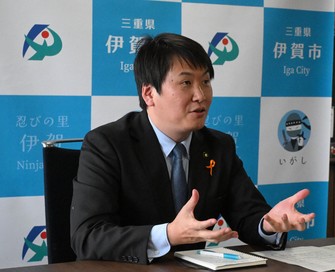
IGA, Mie -- As the Mie Prefectural Government considers ending hiring foreign-national employees, the city of Iga in the prefecture has brought two new foreign employees into city hall this spring under a regular staff hiring category. Forty-two-year-old Mayor Toshinao Inamori, who led the initiative, said he feels momentum is growing to turn diversity into energy and "make it a strength."
Foreign residents began increasing in the city in the 1990s, mainly among people working in manufacturing, and now account for 7.6% of the population. Inamori, a native of the city, said he himself grew up experiencing multicultural coexistence firsthand. While in university, he was also involved in exchange activities among Japanese, South Korean and resident Korean students, and he recalled learning "the appeal of understanding each other's cultures and backgrounds."
After working at a nursing care facility and serving as a city assembly member, he was elected to the prefectural assembly in 2015. That year, he asked what was the assembly's first ever question concerning sexual minorities. At the time, even the term "LGBTQ" had not yet become widespread in Japan, but believing that "my role is to gather voices that have difficulty reaching politics," he continued to work actively on the issue. He says with pride that those efforts led to the 2021 ordinance to build a Mie Prefecture where sexual diversity is mutually respected and everyone can live with peace of mind.
He won his first mayoral election in 2024. One thing that concerned him was that city hall had no foreign-national regular employees.
"Iga is a historic castle town where foreign residents also live. So when I found out they weren't (in the city hall), I felt there must have been some kind of barrier," he said. With that in mind, in April last year the city announced it would create, starting with hiring for fiscal 2026, a "multicultural coexistence promotion category" for permanent residents or special permanent residents aged 18 to 40. The move was also intended to show that city hall is open to not only foreign nationals but to diverse talent.
At first, he said, he heard no opposition. But a few months later, criticism began arriving through the city's website and other channels. What he believes triggered it was the July 2025 House of Councillors election. "Foreigner policy" emerged as an election issue, and parties calling for tighter restrictions drew attention.
"I think it may have been a major turning point in the sense that exclusionary arguments entered politics," Inamori said. Much of the criticism, he went on, was based on false claims contrary to fact, such as the rumor that the city would hire people "even if they cannot speak Japanese."
"I felt the danger of 'online public opinion,' where evidence is treated lightly," he said.
It was then that the prefecture's potential plan to ban hiring foreign staff surfaced. Gov. Katsuyuki Ichimi said at a news conference late last year that he intended to reinstate a nationality requirement as early as fiscal 2026.
"I felt outraged that not only in the prefecture, but foreign nationals working in administrative bodies across the country could find it harder to work," Inamori said.
That same day, he posted a comment on the city's website calling for the move to be withdrawn. In strong language, he denounced it as something that "overturns the progress of building multicultural communities that local society has steadily accumulated over many years through cooperation between the public and private sectors," and said that "discriminatory labeling by the government is tantamount to the prefecture itself endorsing and spreading the baseless rumors overflowing online."
The two foreign employees who started work at Iga City Hall are not receiving special treatment and are busy each day with the same duties as Japanese staff, he said. "I am also hearing positive comments from surrounding workers." But for now, he said, there has been no inspection visit from the prefecture. "They have not looked at the reality of the situation at all. It feels abrupt," he said, his tone sharpening.
Since six cities and one town in the Hanshin area, including Amagasaki, Hyogo Prefecture, became the first in Japan to abolish nationality requirements in 1973, local governments in Japan have gradually opened their doors to foreign nationals over roughly half a century.
"Without looking back on that path, it appears they (the prefecture) are wavering in an exclusionary tide. I want the governor to take seriously the fact that foreign residents in local communities are finding life harder," he said, speaking as one of the local leaders promoting multicultural coexistence.
(Japanese original by Bansho Ishimoto, Tsu Bureau)
komentar
Jadi yg pertama suka

Belum Jadi Warga?
Daftar yuk!