
 Oshiete!
 Berita
  Masjid
 Info Kurs
 Media Jepang
Why are Malaysians demanding the return of elephants from Osaka zoo?
MAINICHI
| Juli 5, 2026
3 0 0
0
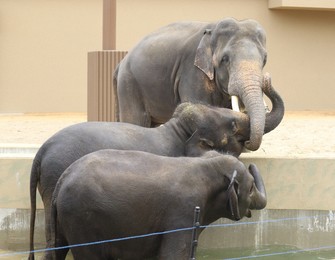
OSAKA -- Criticism is mounting in Malaysia over three elephants that were transferred from there to Osaka Tennoji Zoo in this city's Tennoji Ward, with growing calls for their return. What is driving the backlash?
The zoo is a long-established facility with a 111-year history. It had housed Asian elephants since its opening in 1915. After the Pacific War, it also became known for welcoming Haruko, a young elephant purchased in Thailand by a trading merchant. To commemorate the Osaka Expo in 1970, the Indian government gifted to the zoo the elephant Rani Hiroko, bringing the facility's elephant population to three. But after Rani Hiroko died in 2018, elephant keeping at the zoo was halted.
Restarting its elephant program had become a long-held ambition for the zoo. After repeated discussions with relevant agencies in Asian countries, the zoo in 2022 concluded a deal on the Malaysian Elephant Conservation Program with Zoo Taiping & Night Safari in Malaysia, aimed at elephant conservation and breeding as well as personnel exchanges among staff.
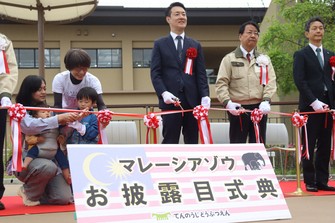
This April, three elephants arrived: Kelat, a 20-year-old male, Dara, a 14-year-old female, and Amoi, a 9-year-old female (ages estimated). It was the zoo's first time keeping elephants in eight years, and long-waiting fans cried out, "They're huge!"
Zoo director Takeshi Mukai said, "We are grateful to the Malaysian government for entrusting us with these precious Asian elephants, which are also called 'a treasure of Malaysia,'" adding with emphasis, "I hope people will learn about the ecology of these overwhelmingly large animals and the importance of living together with wildlife."
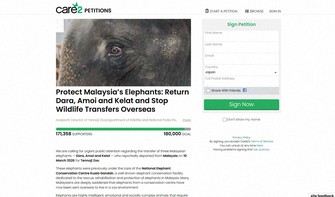
Yet in sharp contrast to the welcoming mood in Japan, a critical atmosphere has spread in Malaysia. Instagram posts calling to "Give the elephants back," along with what appear to be artificial intelligence-generated images, have circulated widely. On the online petition site "care2 PETITIONS," a call demanding the return of the elephants has gathered more than 170,000 signatures, primarily in Malaysia, as the issue has sparked widespread online outrage.
Why has the criticism spread?
In Malaysia, there has long been deep-rooted criticism that displaying elephants that once lived in the wild in urban zoos runs counter to animal welfare. Comments included, "They have the right to return to their homeland and live happily in the forest," and, "Elephants are not suited to a country with four distinct seasons or to a habitat surrounded by concrete."
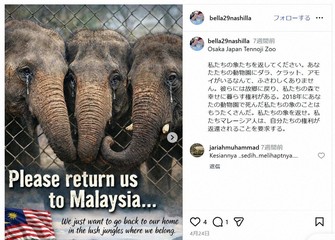
Then another development poured fuel on the fire. In late March, before the elephants were shown to the public, Kelat chipped a tusk. The cause is unknown, and local staff who had come to Japan carried out treatment on the tusks. When the zoo posted images of the procedure on its blog, voices online denounced it as "animal abuse."
Local politicians in Malaysia also moved in response to public opinion. According to local newspapers, Arthur Joseph Kurup, Malaysia's minister of Natural Resources and Environmental Sustainability, said in late April, "Japan's climate does not suit the elephants. We bear responsibility for the welfare of our country's wildlife," and apparently referred to considering the return of the three elephants.
But in reality, returning them is not considered feasible. According to Osaka Tennoji Zoo, all three were found alone as young elephants after being separated from their parents or after their parents had been killed. Since being rescued, they have been raised by humans, and a zoo official said, "Even if they were returned to nature, they do not know how to live in a herd, so they would probably soon die." A local elephant conservation center in Malysia is also already operating at capacity.
The Osaka zoo also pushes back against claims that "the climate does not suit them," or that the arrangement "violates animal welfare." Asian elephants are designated an endangered species by the International Union for Conservation of Nature. The environment Osaka Tennoji Zoo prepared for the three elephants, it says, complies with the strict standards set by the World Association of Zoos and Aquariums. To allow the elephants to live without stress, the zoo spent about 4.5 billion yen (around $27.70 million) to build a vast new elephant enclosure covering about 6,600 square meters. Because hard ground puts a strain on elephants' feet, the entire footing area was covered with sand.
Misako Namiki, a researcher at Teikyo University of Science's institute of life sciences who is knowledgeable about animal welfare, analyzed the controversy by saying, "At the root of the controversy is the growing belief that zoos themselves are incompatible with animal welfare -- the argument that zoos are unnecessary -- and the fact that in Malaysia, details of the 'conservation program' have not been fully communicated."
She added, "It is essential to promote environmental education for visitors and actively communicate the significance of the conservation program. The key is transforming zoos from places where animals are merely displayed into facilities that engage in conservation together with people."
(Japanese original by Deockwoo An, Osaka City News Department)
komentar
Jadi yg pertama suka

Belum Jadi Warga?
Daftar yuk!