
 Oshiete!
 Berita
  Masjid
 Info Kurs
 Media Jepang
Stolen then reclaimed: Tracking tags help fight Japan's surge in solar cable thefts
MAINICHI
| Juli 20, 2026
11 0 0
0
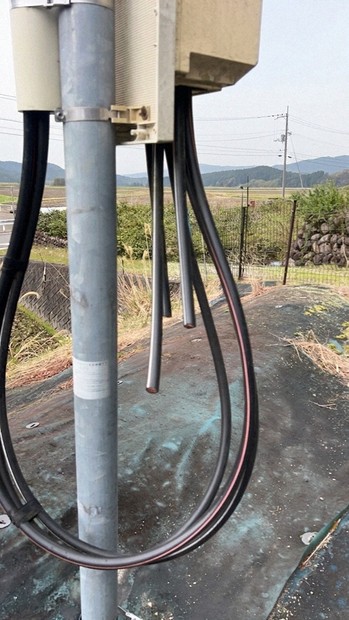
GIFU -- Metal cable thefts targeting solar power facilities are spreading across Japan. Recovering cables severed and stolen by thieves had long been considered nearly impossible. But the president of a company in this central Japan city managed to track down and recover stolen cables himself.
Anger and frustration as thefts continued
"Why are they being stolen? Do something about it!"
Complaints like that kept pouring in from customers of Suzuden Co., a Gifu-based company that handles electrical work and manages solar power facilities. Since 2022, copper cable thefts have repeatedly hit facilities the company oversees in Chiba Prefecture, Shizuoka Prefecture and elsewhere. Total losses have exceeded 40 million yen (around $246,300).
Solar power plants are often located in mountainous areas far from urban centers, with sprawling grounds hidden from public view. Police cannot keep up patrols, and even with security cameras and alarms in place, thieves are often long gone by the time anyone arrives.
A solution costing millions of yen
President Hidetoshi Suzumura, 48, had reached his limit. Preventing theft was the top priority, but no matter how many countermeasures were added, fully stopping it was not easy. If the cables couldn't always be protected, he at least wanted to get them back. That thought led him to begin developing a tag that would allow him to track the location of cables even if they were stolen. The challenge was how to attach tags to long, narrow cables in a way that would not be noticed by thieves. With the help of specialist institutions, he invested tens of millions of yen (hundreds of thousands of dollars) in their development.
After a year and a half of trial and error, the anti-theft system NEOtag was completed.
It uses small tags attached to cables that allow their location to be checked at any time by smartphone or computer. After obtaining a patent, he began introducing the system at facilities connected to Suzuden and other locations.
For security reasons, the details of the tags are a "trade secret," but they are designed so that their attachment points are difficult to identify by sight. The margin of error in the location data is about 5 meters, making it possible to pinpoint almost exactly where the cables are even if they are stolen.
Helping catch thieves

The tags have already proved effective in a real case.
One morning in late March, Suzumura opened his computer and saw that the location data for a copper cable was not showing the facility in Motosu, Gifu Prefecture, where it should have been. Instead, it pointed to a scrap yard about a dozen kilometers away. His bad feeling proved correct. When he rushed to the facility, he found the cables had been crudely severed and taken away. He immediately phoned police and presented the tag location data to Gifu Prefectural Police.
Two weeks later, Gifu police arrested a 55-year-old local worker on suspicion of stealing 46 meters of copper cable with a market value of 244,950 yen (about $1,500). Suzumura was able to retrieve the stolen cables, and while he could not use them again, they could be applied toward compensation for the damage.
Prefectural police praised the effort, attributing the success to "self-initiated crime-prevention efforts." Suzumura expressed confidence in the tag's performance, and said he also expects it to have a psychological effect on theft groups.
"If they know the cables are being strictly monitored with tags, thieves should see that as a risk, and as a result the number of cases in which they are targeted should decline," he said.
New law takes effect to curb damage
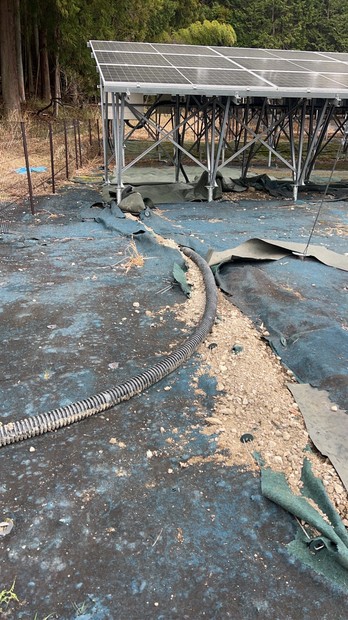
Metal thefts, including those of cables from solar power facilities, have been occurring across the country. In 2024, there were 20,701 such incidents, roughly four times the number recorded in 2020, when statistics began to be compiled. Of those, cable thefts at solar power facilities rose 31.6% from the previous year to 7,054 cases.
The theft of copper cable, whose price has been rising, stands out in particular and accounts for more than half of cases by material type. Theft groups are believed to profit by selling the cables to scrap metal buyers and other purchasers.
In response to the growing seriousness of the problem, the national government enacted a new law strengthening regulation of metal buyers, the Act on the Prevention of the Disposal of Stolen Specified Metals, which fully came into effect in June this year. It imposes restrictions on copper transactions, requiring notification of business operations, verification of sellers' identities, and preservation of transaction records. Unregistered operators face imprisonment for up to six months, a fine of up to 1 million yen (about $6,160), or both.
It is hoped the new law will have a deterrent effect, but voluntary crime-prevention measures are also essential. Since this spring, Suzuden has begun selling NEOtag devices through its group company Miratex Inc., also based in the city of Gifu. The company says it has received inquiries from many businesses.
"There are limits to the effectiveness of existing anti-theft measures such as security cameras," Suzumura said. "We want to spread awareness of the tags throughout the industry."
(Japanese original by Naoki Irie, Gifu Bureau)
komentar
Jadi yg pertama suka

Belum Jadi Warga?
Daftar yuk!