
 Oshiete!
 Berita
  Masjid
 Info Kurs
 Media Jepang
Japan-style GPS faces delay after H3 rocket's failed bid to put satellite in orbit
MAINICHI
| Desember 24, 2025
31 0 0
0
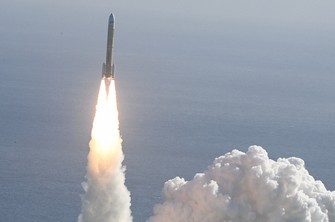
TOKYO -- The Michibiki No. 5 satellite that Japan's H3 rocket failed to put into orbit on Dec. 22 was supposed to form part of a Japanese-style Global Positioning System (GPS). It was meant to insert the sixth piece in the government's planned seven-satellite constellation, and it was hoped the launch would boost Japan's independent system, but the project will now inevitably be delayed.
GPS provides location information for smartphones, car navigation and other such systems and is essential for daily life. However, the system is operated by the United States and covers the entire globe, so its satellites are not always above Japan. Its signals can be blocked by obstacles such as buildings and mountains, leading to false readings and other issues.
To address this, Japan began operating its own "Michibiki" system in November 2018, using four satellites launched between 2010 and 2017. The first satellite which has since been replaced and satellites 2 and 4 follow a special quasi-zenith orbit, covering the area directly above Japan, while satellite 3 functions as a geostationary satellite above the equator.
While the maximum error of the U.S. GPS is about 10 meters, that of the Michibiki system is 1 meter. Furthermore, with a dedicated receiver, accuracy can be as high as 6 centimeters or less. There are expectations for the system's use in many fields, including self-driving buses, unmanned agricultural machinery and drone transport.
However, while this is Japan's own system, it is not fully independent as it partially uses signals from the U.S. GPS and other systems. The reason for this is that a four-satellite system leaves some time zones when Japan cannot be covered. Furthermore, depending on the international situation, security risks that could affect Japan's access also remain a concern. The European Union, China and Russia are also building their own systems.
For this reason, the Japanese government has been advancing launches, aiming for a seven-satellite system capable of independent measurements. In February this year it launched the sixth satellite in the system into geostationary orbit above the equator ahead of the fifth one. The fifth satellite was supposed to operate in an orbit over Japan. The seventh satellite was supposed to be launched in February next year. In a news conference following the recent failure, Atsushi Watanabe of the Cabinet Office's National Space Policy Secretariat, which is in charge of the system, commented, "We want to complete the seven-satellite system as soon as possible. That is all I can say at this time."
Japan only recently faced the bitter experience of losing the Daichi 3 Earth observation satellite, which was supposed to handle the government's disaster response measures and other tasks, in the failed launch of the first H3 rocket in March 2023. Continued failures would leave the government in a difficult situation, unable to independently collect data for positioning and Earth observations.
Nobuaki Kubo, a satellite positioning engineering professor at Tokyo University of Marine Science and Technology, commented, "It was expected that the launch of the fifth satellite would reduce location errors in built-up areas. Location information is now essential for all movements on land, sea and air. Having this as our own country's technology is important for emergencies, so it's disappointing that independent operation is now further away."
Naohiko Kotake, a professor of space systems engineering at Keio University who is familiar with social systems utilizing satellites, commented, "Japan's autonomy in location information is necessary for both security and economic reasons. I hope launches can quickly recover."
(Japanese original by Suzuko Araki and Ryo Watanabe, Lifestyle, Science & Environment News Department)
komentar
Jadi yg pertama suka

Belum Jadi Warga?
Daftar yuk!