
 Oshiete!
 Berita
  Masjid
 Info Kurs
 Media Jepang
US Marine officer opposes closure of key US air base in Okinawa
MAINICHI
| 10 jam yang lalu
9 0 0
0
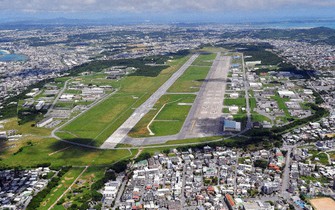
NAHA, Japan (Kyodo) -- A key U.S. air base in Japan's southern island prefecture of Okinawa should be retained even after a replacement facility is completed, and used jointly for American and Japanese forces, a Marine Corps lieutenant colonel argued in a co-authored article recently posted on a U.S. think tank website.
"The decision to close the still-active Marine Corps Air Station Futenma...deserves reassessment," the article in the Atlantic Council said, which also called for renegotiation of a plan to move thousands of Marines from Okinawa to Guam out of concerns that the agreement "risks undermining deterrence" against China.
The article, dated Feb. 3, was written by Lt. Col. Caleb Eames, Marine Corps fellow at the council, and Amy Cowley, assistant director at the council's Scowcroft Center for Strategy and Security. Their views "do not represent the policy of the Marine Corps, the Department of Defense, or the U.S. government," it said.
Japan and the United States agreed on the return of the land used for the Futenma base in 1996 and announced in 2006 a road map for realigning the U.S. military presence in Japan, which included the airfield's relocation from a crowded residential area in Ginowan to the less populated Henoko coastal area of Nago, both in Okinawa.
The relocation plan has met with strong opposition from people in Okinawa, with many demanding that the Futenma base be moved out of the prefecture. The Japanese government has said the relocation to the site adjacent to the Marines' Camp Schwab is "the only solution" to addressing the noise pollution and the risk of accidents posed by the base while maintaining the deterrence provided by the Japan-U.S. alliance.
In the Atlantic Council article, the two writers said Futenma is "a superbly capable, safe" airfield while "the replacement ocean-front runway under construction at Camp Schwab isn't nearly as long or capable."
"Washington and Tokyo should keep both Futenma and the replacement facility in Schwab," they said, adding that the move would "maximize operational flexibility and preserve a vital logistics hub for responses to regional crises."
They also said the shifting of Marines from Okinawa to Guam, also included in the 2006 road map, "undermines deterrence by pulling critical rapid-response forces from the First Island Chain, the first line of major islands running north to south along Asia."
Noting that the realignment plan had been worked out in "very different political and security environments," the article emphasized that "China is accelerating its bid for dominance in the Western Pacific and pressing its claim on Taiwan."
The full implementation of the realignment plan "would give Chinese military planners exactly what they want -- a removal of U.S. forces from the locations where they would be most essential in a First Island Chain conflict," it added.
Due to the legacy of the U.S. occupation after World War II and Okinawa's strategic importance, owing to its relative proximity to China and the Korean Peninsula, Okinawa has hosted the bulk of U.S. military facilities in Japan.
In a statement to Kyodo News, the Marine Corps said it is "continuing to implement the realignment of U.S. forces" and noted that the views expressed by Eames in the article are his own.
komentar
Jadi yg pertama suka

Belum Jadi Warga?
Daftar yuk!