
 Oshiete!
 Berita
  Masjid
 Info Kurs
 Media Jepang
Editorial: With fewer women elected, gender parity lost in Japan lower house poll
MAINICHI
| 9 jam yang lalu
7 0 0
0
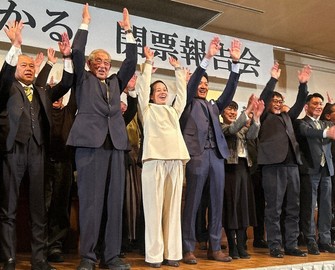
Even though Japan has its first female prime minister, the number of women elected to the House of Representatives has declined. The country remains far from achieving gender parity in the Diet, and fundamental measures are needed.
Sixty-eight women were elected in the Feb. 8 lower house race, accounting for 14.6% of all successful candidates. While this marks the second-highest level on record, it is a drop from the previous general election in 2024. A total of 313 women ran in the latest race, making up a mere 24.4% of all candidates.
This year marks 80 years since women first exercised their right to vote in the first lower house election after World War II. In April 1946, about 13.8 million women voted for the first time and 39 women landed seats in the Diet. Decades on, the number of women elected has not even doubled from that initial figure. This reflects the current state of Japanese society, where the appointment of women to key positions has not advanced.
By party, the ruling Liberal Democratic Party (LDP) has the largest number of women elected, at 39, followed by the Centrist Reform Alliance, the Democratic Party for the People (DPFP) and Sanseito, each with eight. However, women account for only 12.3% of all LDP winners, falling short of Sanseito, the DPFP and others.
Even considering the LDP's large seat numbers and the difficulty for new talent to enter due to prioritizing incumbents, it is problematic that efforts within the party have stalled.
In 2018, the Act on Promotion of Gender Equality in the Political Field took effect, urging political parties to make the number of male and female candidates for national and local elections as equal as possible. However, because it only imposes duties to make efforts, not legally enforceable requirements, a clear path to gender parity is nowhere in sight.
Women make up half the country's population. To reflect the public will, it is desirable for women to hold half of the seats in the political arena, where the systems that shape our society are decided.
If it takes time to achieve this, Japan needs to introduce a quota system that allocates a certain number of candidacies or seats to women. A system should also be considered where party subsidies are reduced if the proportion of female candidates is low.
Japan continues to languish in global gender equality rankings. That said, the landslide victory of the LDP led by Prime Minister Sanae Takaichi is likely not unrelated to the societal sentiment hailing her for breaking the glass ceiling. Seizing this momentum, we call on the prime minister to exercise her leadership and for the ruling and opposition parties to rise to the task of pushing through reforms to achieve gender parity.
komentar
Jadi yg pertama suka

Belum Jadi Warga?
Daftar yuk!