
 Oshiete!
 Berita
  Masjid
 Info Kurs
 Media Jepang
Kyoto exhibition highlights teamwork behind Hokusai and Hiroshige ukiyo-e masterpieces
MAINICHI
| Mei 31, 2026
2 0 0
0
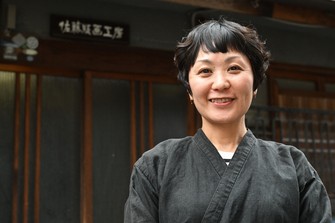
KYOTO -- A special exhibition, "Hokusai and Hiroshige: Works from the Hara Yasusaburo Collection," is underway at the Museum of Kyoto, centering on famed landscape print series by Katsushika Hokusai and Utagawa Hiroshige. While viewers of ukiyo-e tend to focus on the artist, the works were created through the combined efforts of four people: the artist, the woodblock carver, the woodblock printer and the publisher.
Drawn from the collection of businessperson Yasusaburo Hara, who lived from 1884 to 1982, the exhibition features celebrated series including Hokusai's "Thirty-Six Views of Mount Fuji" and Hiroshige's "The Fifty-Three Stations of the Tokaido."
Especially noteworthy among the works on display are the "first editions." These earliest printings are said to reflect most strongly the intentions of the artist and the skills of the carver and printer.
What techniques should viewers look for to deepen their enjoyment of ukiyo-e? The Mainichi Shimbun interviewed Kyoko Hirai, a woodblock printer at the Sato Woodblock Studio in Kyoto's Higashiyama Ward.
Hirai is from Osaka and majored in printmaking at Kyoto Seika University's Faculty of Art. While a student, she took a part-time job at the studio through an introduction from her seminar professor, and that led her into the world of woodblock printmaking. The studio also cooperated in filming public broadcaster NHK's historical drama "Unbound" in 2025.
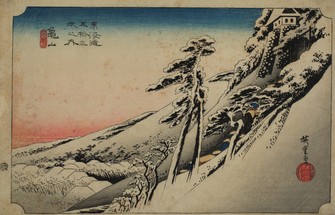
Among printing techniques, one of the most important, Hirai said, is "bokashi," or gradation. One example is Hiroshige's "Kameyama: Clear Weather after the Snow" from the fifty-three stations series.
The work depicts a snowy landscape, making masterful use of the white of the paper to express snow. Across the top of the picture runs a thick blue "ichimonji bokashi," a straight-line gradation, while the edge of the mountains is tinted with a vermilion gradation of dawn light.
"This dynamic gradation beautifully expresses the soft feeling of the morning sky," Hirai said.
Bokashi is created by placing moisture on the woodblock, then putting paste between the dense pigment and the moisture and moving a brush up and down or side to side. The final effect changes depending on the amount of moisture, pigment and paste.
One of the difficulties of printing, she said, lies in finishing large numbers of prints in the same way. It takes five to 10 years before a printer can be entrusted with a single ukiyo-e print. She gave the Hara collection high praise, saying every piece is "uniformly excellent, all in condition above 90 points."
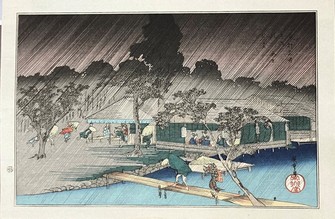
To show how the same work can give a completely different impression depending on the printing, Hirai pointed to Hiroshige's "Famous Places in Kyoto: Sudden Shower at Tadasu Riverbank."
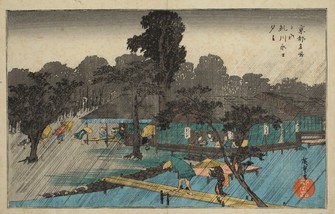
In another printed version, the sky is dark and the lines of rain stand out clearly, making it look like a violent downpour. In the Hara collection version, by contrast, the sky is lightly gradated and bright, suggesting a quick shower that may soon pass. "It captures the atmosphere unique to an evening shower," Hirai said. She added that color tones in printing can also change with the trends of the time and the publisher's intentions.
Hokusai's "Warm Breeze, Fair Weather" from the Thirty-Six Views of Mount Fuji series is widely known by the nickname "Red Fuji." Its composition is simple, with Mount Fuji towering beneath a brilliantly clear sky. Though it uses relatively few blocks and colors, it is unexpectedly "a work that makes printers cry," Hirai said with a wry smile, adding, "If possible, I would rather not print it."
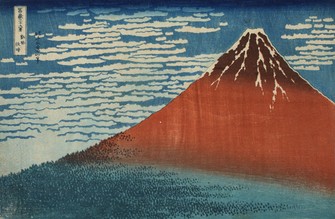
She pointed to the flat red area on the middle slope of Mount Fuji. In the exhibited print, the grain of the woodblock appears beautifully, but to achieve that texture, "You have to reduce the pigment to the absolute limit, apply strong pressure and print evenly," she said.
Behind the birth of landscape prints in the ukiyo-e world was the synthetic pigment "bero-ai," or Prussian blue. It entered Japan in the mid-18th century. Because it was discovered in Berlin, Germany, it was called "Berlin ai (indigo)" in Japanese, shortened to "bero-ai." At first it was expensive, but cheaper Prussian blue from China and elsewhere began to be imported, and its use spread rapidly in ukiyo-e. Its appeal lay not only in its vividness but also in how easily it could produce shades ranging from deep blue to pale blue.
With the arrival of vivid Prussian blue, artists became able to depict "water" and "the sky," and landscape prints emerged in the ukiyo-e world. Without that color, iconic series by Hokusai and Hiroshige might never have come into being.
Indigo tones are originally prone to fading. But the Hara collection has been kept in excellent condition, preserving the original colors. Visitors can appreciate the vivid "Hokusai blue" and "Hiroshige blue" of the period, together with the world created by natural indigo. The exhibition offers a chance to approach the true essence of both renowned artists.
The special exhibition runs through June 14.
(Japanese original by Rika Uemura, Osaka Cultural News Department)
komentar
Jadi yg pertama suka

Belum Jadi Warga?
Daftar yuk!