
 Oshiete!
 Berita
  Masjid
 Info Kurs
 Media Jepang
Editorial: Withdraw male-line adoption plan amid Japan Imperial law revision debate
MAINICHI
| Juli 13, 2026
15 0 0
0
Article 1 of Japan's Constitution states that the Emperor's status is based on "the will of the people." If a system is created that departs from that, it is certain to leave deep trouble for the future.
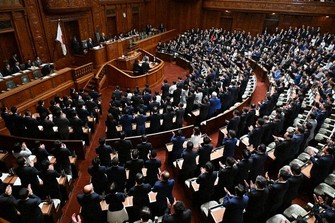
A bill to revise the Imperial House Law has passed the House of Representatives. It would allow female members of the Imperial Family -- including Princess Aiko, 24, the only daughter of Emperor Naruhito -- to remain in the Imperial Household after marriage. It also includes a provision to adopt male-line males from former Imperial Family branches into the Imperial Household.
The adoption plan has many problems, and opinion polls show that public support and opposition are evenly split. Regardless, committee deliberations in the lower house ended after only a little more than three hours, and the bill was put to a vote in a plenary session that same day.
What is baffling is the response of the largest opposition Centrist Reform Alliance. From a cautious standpoint on the adoption plan, it had sought revisions to a supplementary resolution, but in the end it drifted into supporting the bill.
Gov't bears responsibility for breaking consensus
In the House of Councillors, which will begin deliberations on the bill this week, the largest opposition Constitutional Democratic Party of Japan has decided to oppose the legislation. Previously, when a special bill allowing the abdication of then Emperor Akihito (currently Emperor Emeritus Akihito) was enacted, both chambers were almost unanimous. This time, by contrast, the Diet has not reached any such overall consensus.
There were dissenting views on the adoption plan in both the ruling and opposition camps, and some lawmakers abstained or were absent from the vote in the lower house.
Changes to the Imperial system, by their very nature, require broad agreement. That is because they bear on the legitimacy of the Emperor as the "symbol of the unity of the people," as provided for in the Constitution.
And yet, Prime Minister Sanae Takaichi has positioned revision of the Imperial House Law as one of the "policies that divide national opinion." One cannot help but question her judgment. It is unacceptable to force through the adoption plan simply by resorting to strength in numbers, given that it has split public opinion and the views of both ruling and opposition parties.
The purpose of the adoption plan is to secure male-line males whose paternal lineage traces back to an emperor. However, it would apply to descendants of former Imperial Family branches that left the Imperial Household about 80 years ago, and in terms of the male line, they are not connected to today's Imperial Family unless one goes all the way back to the Muromachi period (approx. 1336-1573).
That would give only men from former Imperial Family branches a special status under which they could become members of the Imperial Household, and some argue that this would amount to discrimination based on family origin in violation of Article 14 of the Constitution. The bill contains a provision for a review after 30 years, but once it is written into the Imperial House Law, it could become effectively permanent, deepening the suspicion that it is unconstitutional.
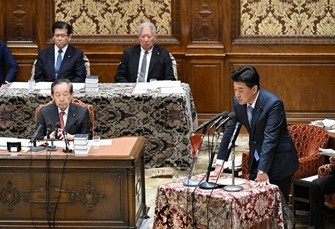
As if the problems already identified were not enough, the bill also includes a provision stating that if a son is born to an adoptee, he would have eligibility for Imperial succession. The view issued by the heads and vice heads of both chambers of the Diet -- dubbed as the "consensus of the legislature" -- was compiled narrowly around measures to secure the number of Imperial Family members, but the provision goes beyond that.
It was obvious that stepping into the question of Imperial succession would provoke a conflict. The result is effectively that a provision maintaining patrilineal succession into the future has been slipped in unilaterally, prompting the opposition to denounce it as a "surprise attack."
This plan had been referred to by lower house speaker Eisuke Mori from the Liberal Democratic Party (LDP), who served as a moderator in consolidating ruling and opposition views. The responsibility for breaking the "consensus" lies with the government and the LDP. The adoption plan should be withdrawn.
By contrast, there is broad agreement between the ruling and opposition blocs on preserving the status of female members of the Imperial Family after marriage. Because it concerns the lives of unmarried Imperial Family members, it must be realized without delay.
Preserve the status of female Imperial Family members
Still, distortions in the proposed system's design cannot be overlooked. Upon marriage, female Imperial Family members would be entered into the basic resident register and treated differently from the Emperor and other members of the Imperial Household.
The status of husbands and children -- on which the ruling and opposition parties differ -- was supposed to have been shelved. But under the government's bill, husbands and children would in effect not become members of the Imperial Family. That would turn the LDP's position into a fait accompli.
It is obvious that this is meant to block any possibility of a female Emperor or a female-line Emperor. As a result of clinging to preservation of patrilineal succession, female Imperial Family members and their families would be subjected to irrational treatment.
The reality is that, without any national debate, the bill has gone so far as to lock in the continuation of patrilineal succession from here on out. Chief Cabinet Secretary Minoru Kihara told the Diet that it was "not intended to prejudge or constrain future consideration," but that cannot be taken at face value.
If the current situation continues, in which female spouses remain under heavy pressure to bear a son, the Emperor system itself will eventually run into a dead end. Unless we remember that the Imperial system is sustained by living, flesh-and-blood people, it can neither be maintained nor acquire empathy.
If the system is to be sustainable, various options must be left open. A reset is needed -- whether by revisiting the government's expert panel discussions or by inviting specialists to testify before the Diet as witnesses.
Awareness of gender equality has spread among the public, and women's participation in society has expanded. The adoption plan, with its fixation on the male line, is out of step with the times. It is far too distant from the post-World War II image of the symbolic Emperor, which has been accepted because the successive emperors have walked together with the people.
The upper house should revise the bill.
komentar
Jadi yg pertama suka

Belum Jadi Warga?
Daftar yuk!