
 Oshiete!
 Berita
  Masjid
 Info Kurs
 Media Jepang
Osaka Expo inspires 3-year-old Japanese boy to ace certification test on world's flags
MAINICHI
| 4 jam yang lalu
5 0 0
0
KAWANISHI, Hyogo -- A 3-year-old boy and his father in this western Japan city passed the top level of the national flag test, an exam that assesses knowledge of the world's flags, this spring. Children can absorb new knowledge as they follow their curiosity from train station names to the lyrics of their favorite songs. Ahead of the summer vacation season, this reporter explored the appeal of "certification tests" that even very young children can enjoy.
Yuma Maeda was fascinated with the national flags of the world, memorizing nearly all 193 U.N. member states. He and his father, Ichihiro, 44, took the parent-child version of the test, in which a parent and child work together so even preschoolers who cannot yet read or write can take part, with a parent writing down the answers.
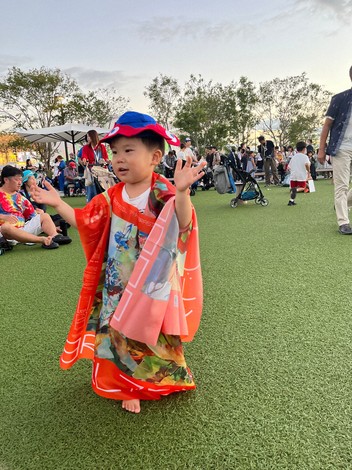
Osaka Expo sparked interest
Yuma's interest in flags began last spring, when he went to the World Exposition in Osaka with his mother, Asumi, 42, and his older sisters Miyu, 17, and Megumi, 15.
On their way back after stopping at pavilions including Brazil's, Yuma, riding in a stroller, looked at rows of national flags near a gate and asked, "What's that?" When Miyu told him, "That's Brazil's flag," he kept asking, "What about that one? And that one?" Megumi also answered what she could, naming countries such as the United States and France.
There were many flags at the expo site, but even his mother and sisters did not know many of them. The family then bought a book about national flags, and Yuma began reading the hiragana he had just learned while smiling as he looked through it. Asumi gave him all sorts of national flag-themed goods, including pencils and handkerchiefs with flag designs. She also found a website where people can make a card game called "Kokki Dobble," (national flag Dobble), which parents and children can enjoy together.
In the game, circular cards display eight different national flags, and any two cards always have exactly one flag in common. Two cards are revealed when players say "Ready, go!" and they race to find the matching flag. The first player to spot the common flag must call out its country name.
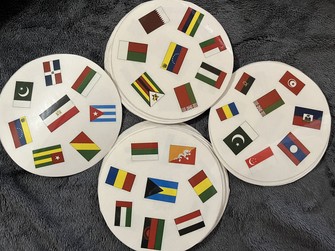
They began playing with well-known national flags such as those of the United Kingdom and Italy and gradually increased the number of flags used. In less than a month, Yuma was able to name flags that even his family members could not recognize.
Since the card game cannot be played unless all participants know the flags, Ichihiro used a smartphone app to memorize them as well. When he realized his son knew nearly all of them, he thought, "Why not make the most of it?" and decided to take Level 1 -- the top level -- of the national flag test together with him.
The test, organized by the Association of International Knowledge Dissemination in Tokyo since 2011, offers Level 5 to Level 1. The passing line for Level 1 is about 80 or more correct answers out of 100. Although the standard test is intended for children in the third grade of elementary school and above, a parent-child version was introduced in August 2020. There is no age limit for participation.
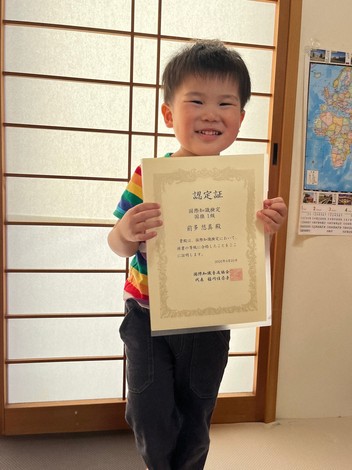
When Ichihiro looked around the examination venue, he saw many children who were around his son's age or one to two years older. Yuma stayed focused throughout the 40-minute test and passed on his first attempt. "My role was simply to write down in katakana the answers that Yuma told me. He really remembers them well," Ichihiro said with wide-eyed admiration.
There was an unexpected side benefit. Yuma also learned to read katakana as he memorized the flags. Recently, his interests have expanded to another card game in which players choose flags that match prompts such as "Which country has the largest land area?," and he has also become interested in country-by-country rankings such as gross domestic products, the sizes of exclusive economic zones and populations.
There are other certification tests that very young children can try as well.
The number and shapes test administered by the Mathematics Certification Institute of Japan in Tokyo is aimed mainly at preschoolers. Children can learn the concepts of "numbers," "quantity" and "shapes" that form the basis of math before entering elementary school.
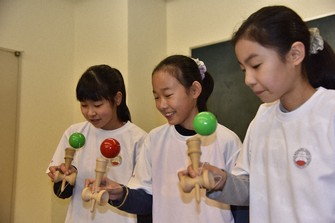
The Kendama Kentei Test run by the Global Kendamas Network, a general incorporated association based in the city of Matsumoto, Nagano Prefecture, tests users' skills with the traditional Japanese "kendama" toy. It is divided into five classes according to difficulty. Its "Medal Challenge," which includes many simple tricks, is designed so that preschoolers can enjoy it too.
Parents, why not try taking a test with your young child this summer?
(Japanese original by Hidenobu Fukuhara, Digital News Group)
komentar
Jadi yg pertama suka

Belum Jadi Warga?
Daftar yuk!