
 Oshiete!
 Berita
  Masjid
 Info Kurs
 Media Jepang
Japan firms turn to survival games to reveal workplace skills, strengthen teamwork
MAINICHI
| 5 jam yang lalu
4 0 0
0
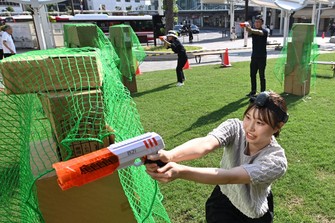
HIRAKATA, Osaka -- Some employee training programs in Japan are now embracing combat games as a hands-on way to build teamwork, reveal communication styles and uncover workplace dynamics that often go unnoticed in traditional classroom instruction.
"Hit!" A shout echoes across the plaza in front of the busy Kuzuha Mall shopping complex in Hirakata, Osaka Prefecture. Adults carrying laser tag guns seem to be enjoying the battle while taking cover behind obstacles made from cardboard boxes.
While it looks like they are simply playing, it is in fact an employee training program built around survival games, commonly referred to in Japan as "sabage."
Sabage is 'well-suited for training'
The program was created by 47-year-old Hideo Nishino, the representative partner of Abeno Ward, Osaka-based CareerBond LLC, which plans and provides entertainment-based corporate training.
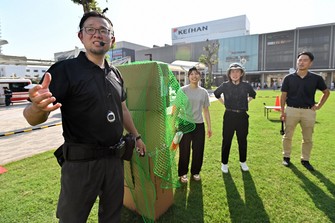
Workplace training is typically conducted through classroom lectures led by instructors. However, Nishino says that this approach often results in poor retention of the material, limited engagement from participants and fewer opportunities to build teamwork.
Unlike many other sports, sabage matches are decided quickly, and differences in physical ability have less impact on performance. As it is also one of Nishino's hobbies, he believed this made the sport well-suited for company training.
Nishino joined Quintbridge, an open innovation facility operated by NTT West Inc. where corporations, startups, local governments and other organizations exchange ideas and share their strengths to develop new businesses. In June 2024, he held an experimental sabage training session with NTT West employees and others. Encouraged by the results and seeing commercial potential, Nishino founded CareerBond in January 2025.
'I thought it was just playing...'
In these training sessions, participants are first given their objectives. Each team then holds a strategy meeting before heading into battle. Instead of airsoft guns that fire plastic BBs, which are commonly used in sabage matches, the program uses laser tag guns. A hit is registered when the infrared beam from the gun strikes a receiver attached to an opponent's head.
Each match lasts only one or two minutes before a winner is decided. After every round, the teams hold a review session, discuss what went well and what did not, and then put those lessons into practice in the next match.
Participants often find themselves shouting commands they would rarely use in everyday work, such as "Forward!" and "Go around from the left!"
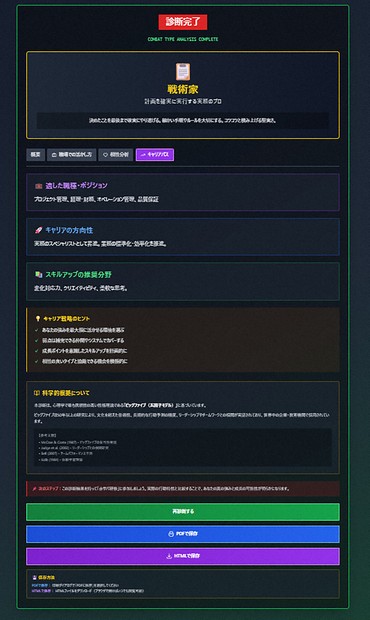
After the training, participants evaluate one another using a checklist. They also complete an aptitude assessment through an app where users are assigned one of eight role types such as "commander," "assault leader" or "coordinator" by answering 25 questions. The app also provides personality insights. The results can serve as conversation starters within the workplace and encourage participants to reflect on any gaps between their personalities and their behavior.
Shoji Ashida, 49, president of local firm Actec Co., took part in the training session described above as a trial participant. He explained, "When I first heard that it was sabage, I thought we would just be playing around. But once we started, everyone had to think about their own role and the movements of their teammates and opponents, allowing team building to happen naturally. It also gave us a chance to interact with people from other departments, so I'd definitely like to use it as work training."
Teppei Shimokawa, 48, the Quintbridge section manager at NTT West who specializes in human resource development, advised the project as it moved toward commercialization. He said, "Split second decisions are required during matches, so people stop worrying about rank or job titles. The biggest strength of this training is that it uncovers relationships and interactions that you can't see in everyday workplace communication."
(Japanese original by Tsutomu Koseki, Osaka Photo and Video Department)
komentar
Jadi yg pertama suka

Belum Jadi Warga?
Daftar yuk!