
 Oshiete!
 Berita
  Masjid
 Info Kurs
 Media Jepang
Japan voters turn on Takaichi Cabinet as support rate plunges: Mainichi poll
MAINICHI
| 11 jam yang lalu
17 0 0
0
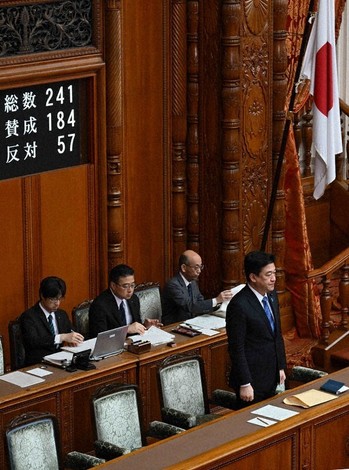
TOKYO -- The approval rate for Japanese Prime Minister Sanae Takaichi's Cabinet plummeted 10 percentage points to 41% in a Mainichi Shimbun opinion poll conducted on July 18 and 19, dropping below 50% for the first time.
The support rate was down from 51% in the previous survey conducted on June 20 and 21. While the government and ruling parties have enacted a revised Imperial House Law to secure the number of Imperial Family members, public support and understanding have not become widespread for maintaining Imperial succession by male-line males. The Cabinet disapproval ratings, at 44%, exceeded the approval ratings for the first time, suggesting that voters are taking an increasingly harsh view of the Takaichi Cabinet.
Asked whether they approved of the revised Imperial House Law, only 19% of all respondents said they did, while 45% said they didn't and 35% said they were not sure. Among supporters of the Cabinet, 38% favored and 20% opposed the revision, while the largest group, at 41%, said they didn't know. Among those who disapproved of the Cabinet, an overwhelming majority, at 77%, said they opposed the revision, while 18% said they were not sure and 5% said they were in favor.
By party affiliation, a little over 40% of supporters of the ruling Liberal Democratic Party (LDP) and its junior coalition partner Nippon Ishin (the Japan Innovation Party, JIP) said they approved of the revised Imperial House Law, exceeding the 20% to 30% who said they did not, while around 30% said they were not sure. Among opposition party supporters, about 80% of those backing the Centrist Reform Alliance said they opposed the amended law, followed by roughly 50% of supporters of the Democratic Party for the People, around 40% of Sanseito supporters and some 60% of Team Mirai backers. The proportion of those against the revision exceeded those in favor across all opposition party supporters, except those backing the Conservative Party of Japan (CPJ). Among respondents with no party affiliation, 46% said they opposed the revision, while 45% said they were not sure and 8% said they were in favor. At present, approval of the revised Imperial House Law has not spread beyond supporters of the ruling parties.

Asked about female emperors not being approved under the revised law, 72% of all respondents said they should be permitted. Just over 60% of LDP and JIP supporters each also said female emperors should be allowed. Among supporters of all other parties except the CPJ, 60% to above 90% said it should be acceptable to have female emperors, surpassing those who said there was no need to do so. On the issue of sons born to female Imperial Family members who remain in the Imperial Household after marriage not being granted eligibility for Imperial succession, 50% said eligibility should be allowed, while 18% said there was no need to do so.
In a free response section asking whether respondents approved of the revised Imperial House Law, many were critical of the government and ruling parties. A woman in her 60s wrote, "Opinions that insist on male-line males are going against the times," while a woman in her 30s said, "I have the impression that it was decided only within the Diet without the details being clearly explained to the public." A man aged over 80 said, "Female emperors should not be excluded," while a man in his 60s commented, "Imperial succession only by male-line males cannot sustain the emperor system, and adopting (male members of former Imperial Family branches) is unreasonable." Some respondents gave favorable views, with a man in his 30s saying, "The amended law is effective in addressing the declining number of Imperial Family members," and a man in his 40s commenting, "It is an appropriate measure in line with Imperial Household tradition."
(Japanese original by Muneyoshi Mitsuda, Poll Office)
komentar
Jadi yg pertama suka

Belum Jadi Warga?
Daftar yuk!